
13/13
Critical-size femoral defects fully bridged.
12 wk
Full bone restoration.
>99.7%
Decellularization.
PNAS
Peer reviewed, 2026
Two applications,
one core technology.
OssiGel's platform works in two directions: repairing bone where it's broken, and building a bone marrow niche wherever scientists need one.
Bone regeneration
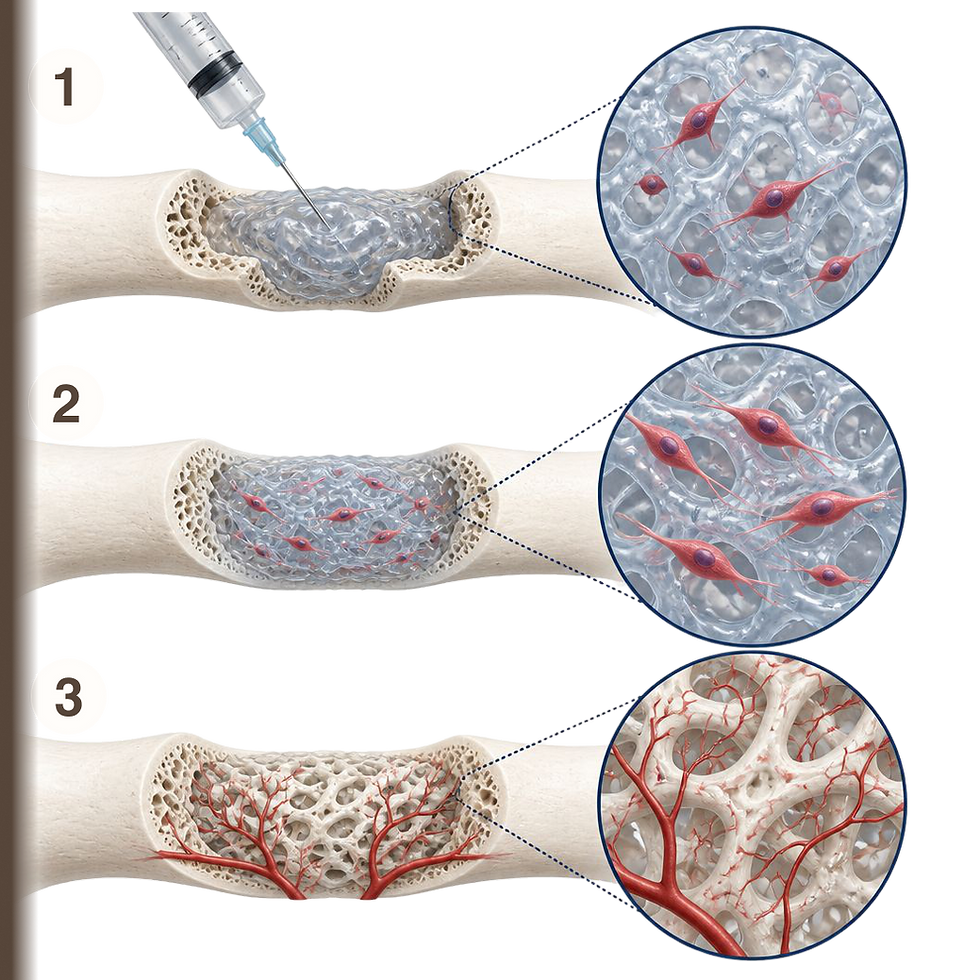
Instructs the body to regrow bone through endochondral ossification, without implanted cells or donor tissue.


OssiGel: engineered human cartilage, made cell-free
OssiGel is a cell-free bone graft substitute made from engineered human cartilage. It contains no living cells and no recombinant proteins added at therapeutic dose. Instead, the graft's own extracellular matrix instructs the surrounding tissue to form bone through endochondral ossification, the same process the body uses to heal a fracture.

Bone marrow modeling
Generates humanized ossicles (hOss) for in vivo disease modeling, replacing animal-derived niches with patient-specific ones.
93%
ossicle (hOss)
formation success rate across AML patient samples
269
patient-derived patient-derived hOss generated
success held regardless of ELN risk classification

Bone regeneration
Instructs the body to regrow bone through endochondral ossification, without implanted cells or donor tissue.
13/13
DEFECTS FULLY BRIDGED
Critical-sized femoral defect, rat model
12 wk
TO FULL RESTORATION
Morphological and mechanical
Matches high-dose rhBMP-2 and syngeneic living cartilage graft, without their complexity or cost
Two applications,
one core technology.
OssiGel's platform works in two directions: regenerating bone in the body, and modeling bone marrow outside it.

Get the data
Non-confidential summaries prepared for research and BD teams evaluating the platform.
OssiGel is an investigational product in preclinical development (TRL4). It is not available for patient use.